
What Global Buyers Check Before Choosing Indian Suppliers
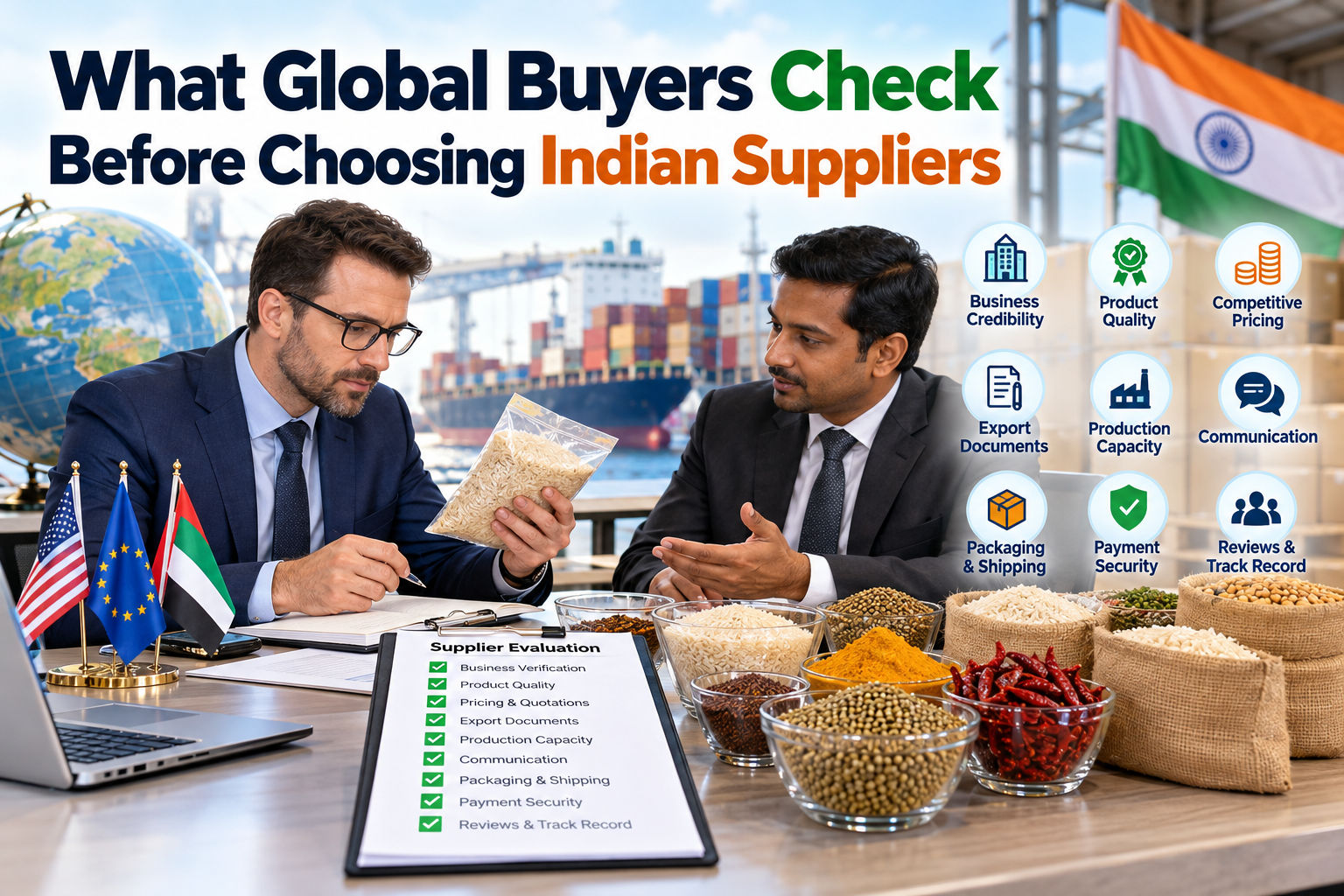
What Global Buyers Check Before Choosing Indian Suppliers
India is a major sourcing destination for international buyers looking for agricultural commodities, spices, textiles, food products, industrial materials and other wholesale goods. However, choosing the right supplier involves more than comparing prices. Global buyers need confidence in product quality, business credibility, communication, export documentation and delivery commitments before placing an order.
For importers, wholesalers, distributors and manufacturers, selecting a reliable Indian supplier can help reduce sourcing risks and build long-term international trade relationships. Understanding what buyers evaluate before making a purchasing decision can also help Indian exporters present their businesses more professionally.
In this guide, we explain the key factors global buyers should check before choosing Indian suppliers and how businesses can prepare for successful international trade.
1. Business Verification and Supplier Credibility
Business credibility is one of the first factors international buyers should evaluate when sourcing products from India. Buyers want to know whether they are dealing with a genuine manufacturer, exporter, wholesaler or trading company.
Before starting negotiations, buyers can review the supplier's registered business name, official address, contact details, business website and available registration documents. They should also check whether the company's product range and business activities match the requirements of the proposed transaction.
For Indian suppliers, relevant documents may include GST registration, Importer Exporter Code (IEC), and industry-specific registrations or certifications where applicable. These documents should be checked against the issuing authority's records whenever verification facilities are available.
Buyers should remember that possessing a registration document does not automatically guarantee product quality or transaction reliability. Independent checks, clear communication and consistent business information are equally important.
2. Product Quality and Technical Specifications
Product quality is another important consideration when choosing an Indian supplier. International buyers need products that meet their commercial requirements, destination-country regulations and intended applications.
Before requesting a quotation, buyers should clearly define the required product specifications. Depending on the product category, these may include grade, size, moisture content, purity, composition, dimensions, packaging and acceptable quality tolerances.
For example, an importer sourcing Indian basmati rice may evaluate grain length, broken grain percentage, moisture level, variety and cooking characteristics. A buyer sourcing turmeric may check curcumin content, colour, moisture, microbial quality and applicable food safety requirements.
Buyers can request product samples, laboratory reports, inspection certificates or other supporting documents when appropriate. For bulk orders, they should agree on the inspection method and acceptance criteria before production or shipment.
Indian suppliers can strengthen buyer confidence by providing accurate product specifications, recent quality documentation and clear information about available grades.
3. Competitive Pricing and Transparent Quotations
Price is important, but the lowest quotation does not always represent the best purchasing decision. International buyers should compare quotations using the same product specifications, order quantity, packaging requirements and delivery conditions.
A professional supplier quotation should clearly state the product description, grade, quantity, unit price, packaging, production or dispatch timeline, payment terms and quotation validity.
Buyers should also understand the difference between common international trade pricing arrangements.
- EXW (Ex Works): The seller makes the goods available at the agreed location, with the buyer generally responsible for arranging collection and subsequent transport.
- FOB (Free On Board): Under the applicable Incoterms® rules, the seller handles the required delivery and export-clearance responsibilities up to loading the goods on board the nominated vessel at the agreed port.
- CIF (Cost, Insurance and Freight): The seller arranges and pays the cost and freight to the named destination port and obtains the insurance required under the applicable rule. Risk transfers to the buyer when the goods are on board the vessel at the port of shipment.
These terms are generally used for sea and inland waterway transport. Buyers and suppliers should specify the named port and applicable Incoterms® version in their contracts.
Comparing the full transaction cost, including freight, insurance, customs duties and other applicable charges, helps buyers make informed sourcing decisions.
4. Export Documentation and Regulatory Compliance
International shipments require appropriate documentation and compliance with the rules applicable to the product and destination market. Missing or incorrect documents can lead to customs delays, additional costs or shipment complications.
Depending on the transaction, buyers may need a commercial invoice, packing list, bill of lading or air waybill, certificate of origin and relevant inspection or insurance documents.
Agricultural products and food commodities may require additional documentation, phytosanitary certificates, health certificates, laboratory reports or other approvals depending on the product and importing country's regulations.
For example, import requirements for Indian rice, spices, pulses and fresh agricultural produce can differ considerably between destination markets. Buyers should confirm the applicable requirements with the relevant customs authority, food safety regulator or qualified trade professional before shipment.
Indian exporters should clarify which documents they can provide, who will arrange each document and whether any additional certification is required for the buyer's market.
5. Production Capacity and Order Fulfilment
Before placing a bulk order, international buyers should determine whether a supplier can fulfil the required quantity within the agreed timeframe.
A supplier may offer an attractive price but still be unsuitable if production capacity, available stock or packaging facilities cannot meet the buyer's requirements.
Buyers should ask about current stock, monthly production capacity, lead time, minimum order quantity (MOQ), packaging options and the possibility of repeat orders. For seasonal agricultural commodities, availability and prices may change according to harvest conditions and market supply.
For large or recurring orders, buyers can discuss production schedules, inspection milestones and shipment plans in advance. Written agreements help both parties establish clear expectations and reduce misunderstandings.
Suppliers should provide realistic delivery commitments rather than promising timelines they cannot consistently meet.
6. Communication and Responsiveness
Clear communication plays a significant role in international business relationships. Buyers often work across different time zones, languages and commercial practices, making timely and accurate responses particularly valuable.
A reliable supplier should be able to explain product specifications, pricing, packaging, payment terms and shipping arrangements without unnecessary ambiguity.
Buyers should observe whether the supplier responds professionally, answers technical questions, shares requested documents and communicates changes promptly.
Indian exporters can improve their credibility by using professional business email addresses, maintaining updated company information and providing complete quotations. They should also clarify who will handle order coordination, quality questions and shipment updates.
Consistent communication before the order is placed can help establish expectations for the entire transaction.
7. Packaging, Labelling and Shipping Arrangements
Packaging requirements vary according to product type, transport method, shelf life and destination-market regulations.
For bulk agricultural commodities, buyers may request woven polypropylene bags, jute bags, food-grade liners or other suitable packaging. Retail-ready products may require smaller packs, branded labels, ingredient declarations, batch information and destination-specific labelling.
Before confirming an order, buyers should discuss packaging material, bag weight, labelling language, palletisation where applicable and protection against moisture or physical damage.
Shipping arrangements should also be clarified, including the loading port, destination port, estimated transit time, freight arrangements and responsibility for handling relevant charges.
For perishable products, buyers may need additional arrangements for temperature control, ventilation or refrigerated transportation.
Agreeing on these requirements before production helps prevent avoidable disputes and delivery problems.
8. Payment Terms and Transaction Security
Payment arrangements should be agreed upon clearly before an international order is confirmed. Buyers should understand the payment schedule, currency, banking details, applicable fees and conditions for releasing payments.
Depending on the transaction and the parties' commercial relationship, payment methods may include advance payment, a documentary letter of credit or other mutually agreed arrangements.
Buyers should independently verify bank account changes and confirm payment instructions through a trusted communication channel. Unexpected requests to transfer funds to unrelated accounts deserve additional scrutiny.
For a new supplier relationship, buyers can consider appropriate due diligence, independent inspection and payment arrangements that match the transaction's risk profile.
Both parties should ensure that the purchase order or sales contract documents the agreed product specifications, quantity, price, delivery terms and dispute-resolution arrangements.
9. Supplier Reviews, References and Track Record
A supplier's business history can provide useful context, although it should not be treated as a guarantee of future performance.
International buyers can review available customer feedback, request relevant trade references and examine evidence of experience supplying comparable products or markets. Where possible, references should be checked independently.
Buyers should also distinguish between verifiable business information and unsupported marketing claims. A professional website, positive testimonials or an online listing can be useful starting points, but none independently proves that a supplier is trustworthy.
For significant orders, buyers may consider a third-party inspection, a trial order or another proportionate verification step before entering a larger commercial commitment.
10. Using B2B Marketplaces to Discover Indian Suppliers
Online B2B marketplaces can help international buyers discover suppliers, compare product offerings and initiate business conversations without relying exclusively on personal contacts.
When using a B2B marketplace, buyers should evaluate the quality of supplier information, availability of product specifications, responsiveness to enquiries and the verification procedures offered by the platform.
ExportBusinessMart.com provides a platform for businesses interested in discovering international trade opportunities and connecting with relevant buyers and suppliers. Buyers and exporters can explore relevant product categories and business enquiries to identify potential sourcing or sales opportunities.
However, buyers should conduct their own due diligence before entering into a transaction. A marketplace listing should be treated as a starting point for supplier evaluation, not as a substitute for independent verification.
Conclusion
Choosing the right Indian supplier requires a balanced assessment of business credibility, product quality, pricing, export documentation, production capacity, communication, packaging and payment security. International buyers who evaluate these factors systematically can make more informed sourcing decisions and establish stronger business relationships.
Indian exporters can improve their chances of attracting serious enquiries by maintaining accurate business information, providing transparent quotations, sharing relevant quality documents and communicating realistic delivery commitments.
For businesses looking to expand their international sourcing or export networks, platforms such as ExportBusinessMart.com can provide an additional channel for discovering relevant trade connections. Combining online supplier discovery with careful verification and clear commercial agreements creates a stronger foundation for sustainable global trade.
Frequently Asked Questions
International buyers can use B2B marketplaces, industry directories, trade exhibitions, business associations and referrals to identify potential Indian suppliers. They should verify credentials, review product specifications and assess the supplier's ability to meet their requirements before placing an order.
Depending on the transaction, buyers may review business registration details, GST registration, Importer Exporter Code (IEC), product-specific certifications and relevant quality or inspection documents. Requirements vary by product and destination country.
Buyers can request samples, detailed specifications, laboratory reports and third-party inspection where appropriate. Acceptance criteria should be agreed upon before the order is confirmed.
A useful enquiry includes the product name, grade, required quantity, specifications, packaging, destination country or port, preferred delivery terms and expected order schedule.
Yes. B2B marketplaces can help buyers discover potential suppliers and submit business enquiries. Buyers should still independently verify the supplier, product quality, payment details and contractual terms before completing a transaction.