
Basmati Rice vs Non-Basmati Rice: Differences, Prices & Export Markets
Basmati Rice vs Non-Basmati Rice: Differences, Prices & Export Markets
Rice is one of the most widely traded food commodities in the international market, and India is a major supplier of both Basmati and Non-Basmati rice. Although both categories come from the same staple grain family, they differ considerably in aroma, grain characteristics, processing, pricing, cooking properties, and export markets.
For international buyers, importers, wholesalers, distributors, and food businesses, understanding these differences is important when selecting the right rice for a particular market. This guide explains the key differences between Basmati Rice vs Non-Basmati Rice, including varieties, quality, pricing factors, and export opportunities.
What Is Basmati Rice?
Basmati rice is a premium long-grain rice traditionally associated with the Indian subcontinent. It is recognized for its characteristic aroma, slender grains, and ability to elongate significantly during cooking.
Indian Basmati rice is available in several varieties and processing forms, including 1121 Basmati, 1509 Basmati, 1718 Basmati, Pusa Basmati, Raw Basmati, Steam Basmati, and Sella Basmati.
Sella Basmati, including Golden Sella, is parboiled before milling, while Steam Basmati undergoes steam treatment. These processing methods can influence the texture, appearance, cooking time, and end use of the rice.
Basmati rice is widely used for biryani, pulao, restaurants, catering, premium retail products, and foodservice applications.
What Is Non-Basmati Rice?
Non-Basmati rice refers to rice varieties that do not fall under the Basmati category. India produces a wide range of Non-Basmati varieties to meet different consumer, commercial, and industrial requirements.
Common varieties include IR64, Swarna, Sona Masoori, PR11, PR14, Ponni, HMT, Kolam, and other regional varieties.
Non-Basmati rice is available in different grain lengths and processing forms, including raw rice, parboiled rice, steamed rice, and broken rice. Depending on the variety and specification, it can be supplied for retail consumption, institutional use, food processing, and bulk international trade.
Basmati Rice vs Non-Basmati Rice: Key Differences
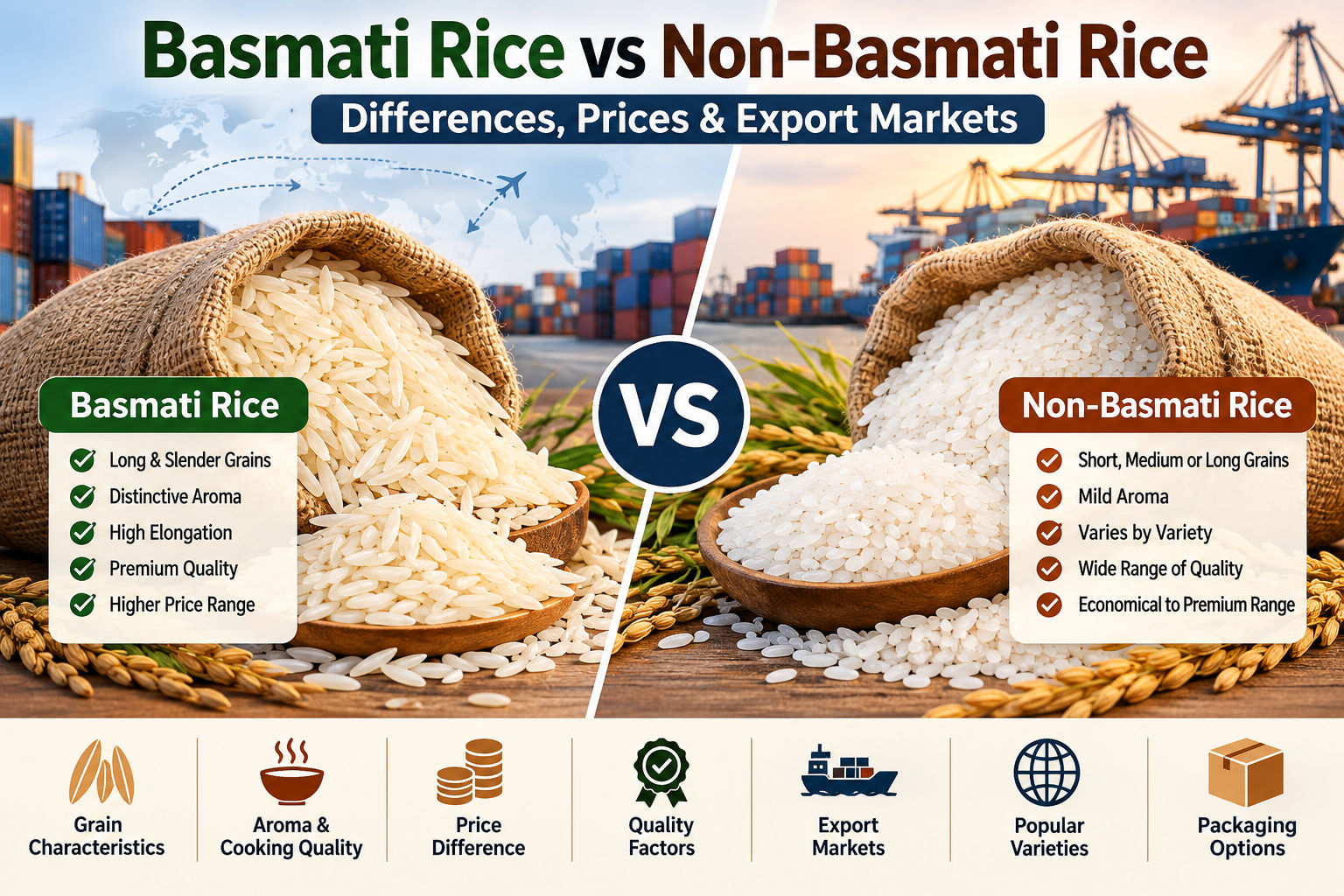
| Feature | Basmati Rice | Non-Basmati Rice |
|---|---|---|
| Grain shape | Long and slender | Short, medium or long depending on variety |
| Aroma | Distinctive natural aroma | Usually mild or neutral |
| Cooking expansion | High elongation after cooking | Varies by variety |
| Texture | Usually separate and fluffy | Depends on variety and processing |
| Price | Generally positioned in the premium segment | Wide range from economical to premium |
| Main applications | Biryani, restaurants, premium retail | Everyday consumption, foodservice and processing |
| Export markets | Middle East, Europe, USA and other markets | Africa, Asia, Middle East and other markets |
| Varieties | 1121, 1509, 1718, Pusa and others | IR64, Swarna, Sona Masoori, PR11 and others |
The exact characteristics can vary according to variety, crop quality, processing method, milling specifications, and buyer requirements.
Difference in Rice Grain Length and Quality
Grain length is an important consideration for international rice buyers. Basmati rice is particularly known for its slender appearance and substantial elongation after cooking.
However, rice quality is not determined by grain length alone. Buyers may also evaluate:
- Moisture content
- Broken grain percentage
- Foreign matter
- Damaged or discoloured grains
- Milling quality
- Purity
- Average grain length
- Grain uniformity
- Cooking characteristics
- Packaging and labeling requirements
For Non-Basmati rice, specifications can vary substantially between varieties and destinations. A buyer purchasing IR64 parboiled rice, for example, may have very different requirements from a buyer purchasing Sona Masoori or broken rice.
Basmati Rice vs Non-Basmati Rice: Price Difference
There is no single fixed price for either Basmati or Non-Basmati rice. Export prices change according to several market and product factors.
Basmati rice generally commands a higher price because of its premium positioning, aroma, grain characteristics, variety, processing, and demand in international markets.
For example, the price of 1121 Basmati rice can differ considerably from 1509 or another Basmati variety. Similarly, Golden Sella, Steam and Raw Basmati can have different prices depending on specifications.
Non-Basmati rice covers a much broader price range. Factors such as grain variety, broken percentage, parboiling, crop season, milling quality, order quantity, destination, freight costs, and payment terms can all affect the final export quotation.
Therefore, international buyers should compare rice quotations based on complete specifications and Incoterms, rather than comparing only the price per metric ton.
Major Export Markets for Indian Basmati Rice
Indian Basmati rice has established demand across several international markets. Important destinations include countries in the Middle East, Gulf region, Europe, North America, and other parts of the world.
Markets such as Saudi Arabia, Iran, Iraq, United Arab Emirates, United Kingdom, United States, Kuwait, and Qatar have significant demand for Basmati rice, although market conditions and import requirements can change over time.
Basmati rice is particularly suitable for markets where consumers value aromatic, long-grain rice for traditional dishes, restaurants, catering, and premium retail.
Major Export Markets for Indian Non-Basmati Rice
Indian Non-Basmati rice serves a different but equally important international market.
Countries across Africa, Asia, the Middle East, and other regions import different varieties of Non-Basmati rice. Demand can be driven by affordability, local food preferences, population requirements, institutional consumption, and food-processing applications.
West African markets are particularly relevant for several Indian Non-Basmati varieties and parboiled rice grades. However, the preferred variety, grain specification, packaging, and broken percentage can differ from one destination to another.
This makes understanding the buyer's exact requirement essential before preparing an export quotation.
Which Rice Is Better for Export?
There is no universal answer to which category is better. The right choice depends on the target market, buyer preference, application, quality specification, and purchasing budget.
A premium retailer or restaurant looking for aromatic long-grain rice may prefer Basmati. A bulk importer supplying affordable staple rice may prefer a suitable Non-Basmati variety.
For exporters, the important point is to match the rice variety and specification with the destination market, rather than treating Basmati and Non-Basmati rice as interchangeable products.
Packaging Requirements for Rice Exports
Rice can be supplied in different packaging formats depending on the destination and buyer requirements. Common export packaging includes:
- 5 kg and 10 kg retail bags
- 20 kg and 25 kg bags
- 40 kg and 50 kg bulk bags
- Laminated polypropylene bags
- Woven PP bags
- Jute bags
- Customized private-label packaging
Bulk buyers may also request customized packing, printed bags, container loading specifications, or private-label packaging.
The packaging should comply with the destination country's food labeling, weight, marking, and import requirements.
How International Buyers Choose Between Basmati and Non-Basmati Rice
Importers generally consider more than price before placing an order. They may evaluate:
- Rice variety and origin
- Grain length and appearance
- Broken percentage
- Moisture and purity
- Processing type
- Cooking characteristics
- Packaging
- Required certifications
- Supplier reliability
- Delivery terms and payment conditions
For this reason, exporters should provide a clear product specification sheet along with their quotation.
Find Basmati and Non-Basmati Rice Buyers
Indian rice exporters can reach international buyers by presenting detailed product specifications, packaging options, minimum order quantities, certifications, and shipping capabilities. ExportBusinessMart can help exporters and suppliers connect with buyers and importers looking for agricultural products, including different varieties of rice. A detailed supplier profile and accurate product information can make it easier for international buyers to evaluate suitable suppliers.
Conclusion
The difference between Basmati Rice vs Non-Basmati Rice goes beyond grain size and price. Basmati rice is generally associated with premium quality, distinctive aroma, slender grains, and strong demand in premium food markets. Non-Basmati rice includes a much wider range of varieties that serve everyday consumption, bulk trade, foodservice, and processing requirements.
For exporters, the most important step is to understand the destination market and buyer specifications before selecting a rice variety. Factors such as grain length, broken percentage, processing method, quality, packaging, order quantity, and delivery terms should all be considered when preparing an international rice quotation.
With the right product-market match, Indian suppliers can serve buyers looking for both premium Basmati rice and competitively priced Non-Basmati rice across global markets.
Frequently Asked Questions
1. What is the main difference between Basmati and Non-Basmati rice?
The main differences are grain characteristics, aroma, cooking properties, varieties, and market positioning. Basmati rice is known for its distinctive aroma and slender grains, while Non-Basmati rice includes a wider range of varieties with different grain sizes and characteristics.
2. Is Basmati rice more expensive than Non-Basmati rice?
Generally, Basmati rice is positioned at a higher price level than many Non-Basmati varieties. However, the actual price depends on the variety, quality, processing method, grain length, broken percentage, order quantity, destination, and shipping terms.
3. Which countries import Basmati rice from India?
Indian Basmati rice is exported to markets across the Middle East, Gulf region, Europe, North America, and other regions. Saudi Arabia, Iran, Iraq, the UAE, the United Kingdom, the United States, Kuwait, and Qatar are among the important markets for Indian Basmati rice.
4. Which Non-Basmati rice varieties are exported from India?
India exports several Non-Basmati varieties, including IR64, Swarna, Sona Masoori, PR11, PR14, Ponni, HMT, and Kolam. The preferred variety depends on the destination market and buyer requirements.
5. What factors affect the export price of Indian rice?
Rice export prices can be affected by variety, grain length, broken percentage, moisture, quality, processing method, crop availability, order quantity, destination, freight costs, packaging, and Incoterms such as FOB or CIF.
6. How can international buyers find Indian Basmati and Non-Basmati rice suppliers?
International buyers can search B2B marketplaces and supplier directories to compare Indian rice exporters based on product specifications, packaging, minimum order quantity, certifications, and shipping capabilities. ExportBusinessMart provides a platform where buyers can discover suppliers and rice-related business opportunities.